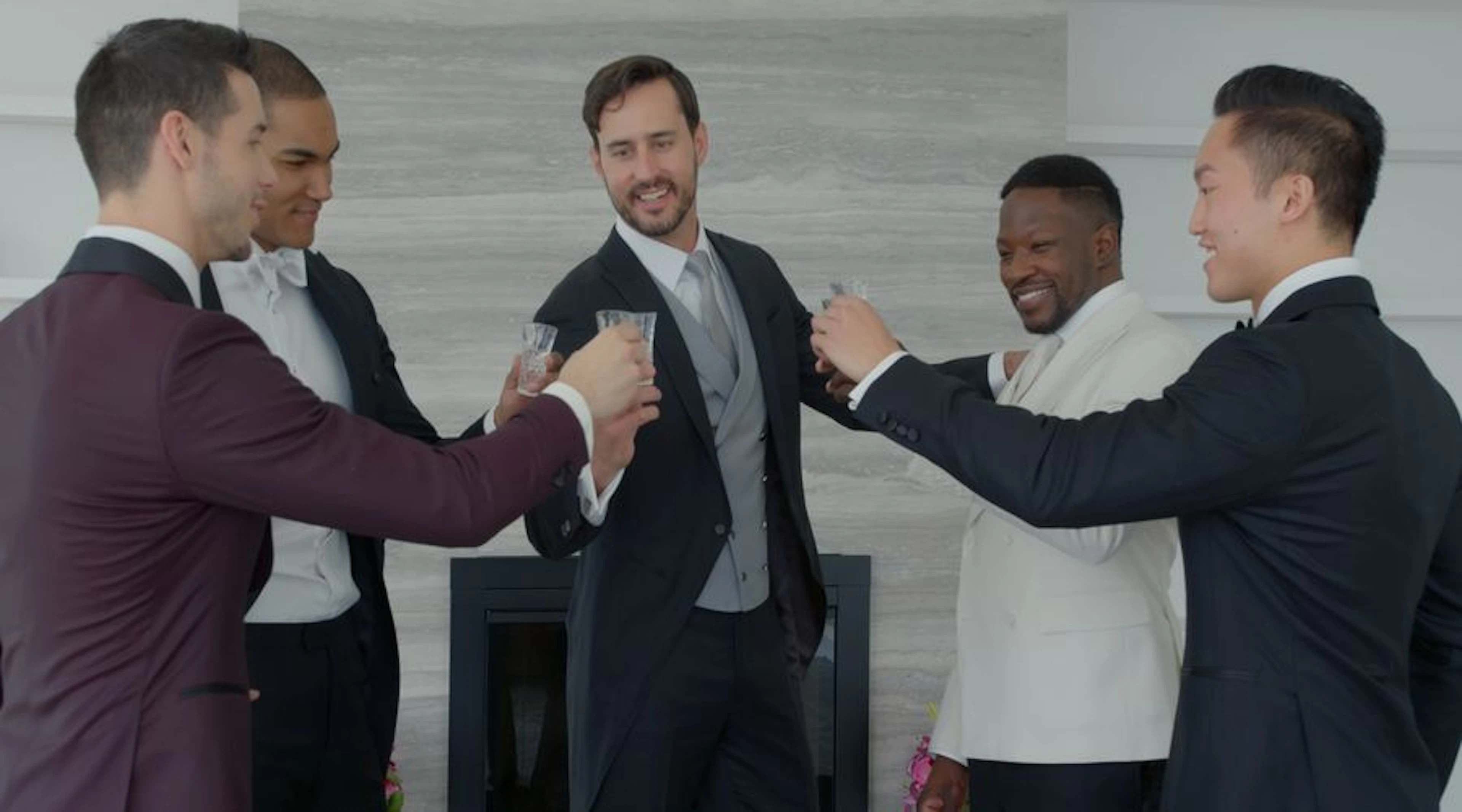
Vents, Lapels, and Buttons: All The Details That Round Out A Custom Suit
A custom suit encompasses more than just premium fabric, perfect fit, and unmatched style. While it's true that aspects such as color, style, and fit tend to be the first things we notice when it comes to formal wear, it's the hidden details that effortlessly push those more obvious parts of a custom suit to the forefront.
A custom suit encompasses more than just premium fabric, perfect fit, and unmatched style. For any formal wear worth its salt, it goes without saying that the finer details are what elevate an ensemble above the ordinary, down to every last stitch, button, and crease. While it's true that aspects such as color, style, and fit tend to be the first things we notice when it comes to formal wear, it's the hidden details that effortlessly push those more obvious parts of a custom suit to the forefront.
As far as personal fashion sensibility goes, it would cease to exist at all without those subtler parts of custom tailoring. In order for one's own style to really shine through, the constituent components of a custom suit need to gel and come together just the right way for the individual wearing it. And of course, time and place matter, too. What style works for someone in an office setting might not be the best choice for a wedding or cocktail party; for others, their personal style may be interchangeable no matter the time of day or the venue. With custom design, there are so many variables at play, and that's a good thing from a style perspective.
Since so many components, design schematics, materials, and aesthetic nuances go into the finished product, it's sometimes difficult to grasp how all of these different aspects work symbiotically to give a custom suit, tailored to a specific individual, that sense of style they've been looking for but could never quite nail down. Since we've updated our custom suit visualizer, getting a better picture of what your finished product will look like has never been easier, all the way from the vents in the back of the jacket down to every last thread of fabric. In this piece, we'll go over some of those finer details that take custom suits to the next level.
--Vents--
It tends to be one of those things that we hardly notice or even look for. But they can go a long way in determining the formality of a particular ensemble. Chances are, you might not even know the exact number of suits in your wardrobe that have only one vent, two vents, or none at all off the top of your head. It's certainly something most of us don't even think about after a purchase, but the vents on a jacket can do quite a lot in setting the overall tone and style of a given suit. Although vents mainly serve the functional purpose of making it more comfortable to wear a suit in a sitting position, they do have style implications as well.
Following archetypal classic American sensibilities, many suit jackets on the market today contain only one vent, and there's a reason why this sleek yet minimal style remains a popular choice for gentlemen around the world. The center or single vent, as it is also known, is an excellent choice for all body types and works well in both formal and informal settings. A standard feature on many two-piece suits, the single vent also makes its appearance on sport coats and blazers, thanks in large part to its versatility and ease of manufacture. For men who lean toward a subtler, no-frills classic style, the center vent combines minimalism and just a touch of flair for a refined yet laid-back aesthetic that's certainly not falling out of fashion any time soon.
Suit jackets with two vents, also known as double or side vents, have some functional advantages over the more common center-vent style. The extra space provided by two vents rather than one allows for easier movement and more comfort when sitting down. Side vents also reduce bunching and creasing that can occur at the back of the jacket when in a sitting position for long periods of time. Stylistically, many gentlemen consider side vents to ratchet up a suit's perceived formality and finesse, and they would be right, to a degree. Wearing a suit with side vents is harder to pull off correctly, as it requires much greater precision in terms of getting the proper measurements and fit in order to achieve the intended visual effect. Side vents have the ability to not only slim down a person's figure but also add an inch or two in terms of a person's perceived height due to the vertical creases on the back of the jacket. So long as you weigh the potential pros and cons of a double-vented suit, proper tailoring and a precise fit can bring your personal style to the next level.
Less common than center or double vents, some suits come with no vent at all. This is actually the standard for tuxedos worn in formal black-tie settings. At the expense of additional comfort, a suit with no vents that is tailored accurately can provide a very sleek and uniform appearance. The drawback, of course, is that the jacket may be prone to more bunching and unwanted creases, but it's an option to consider, especially if you have a slimmer build.
--Buttons--
Even more elusive to the eye than jacket vents, not too much thought is given to the buttons on a suit, as they predominantly serve a functional rather than aesthetic purpose. However, buttons can provide a suit with a subtle, refined attention to detail that other components are often unable to do. Just like cufflinks and lapel pins, buttons can round out a suit's overall style not in spite of their perceived insignificance but because of it.
In the case of tuxedos, the buttons are usually made from the same material as the jacket itself. For many custom suits made with formality in mind, buttons generally match the material of the suit in some way, whether by color or even the type of fabric. But when it comes to buttons, more flexibility is available from a fashion standpoint. Depending on the fabric's color, for example, pairing black buttons with a neutral grey suit can make a bold style statement when done confidently, as the accents from offset colors allow a suit to really stand out in a good but almost imperceptible way. With this in mind, there are, however, a few hard and fast rules for buttons on a suit.
First and foremost, the smaller buttons normally found on the jacket sleeve should always match the buttons on the front of the jacket. Mixing and matching colors between the buttons themselves, however slight, will throw off a suit's stylistic symmetry.
How you fasten the front buttons on a suit jacket is also just as important from a style perspective. For two-button suits, the top button should always be fastened while the bottom one should remain unbuttoned. If you decide to go with a suit that has three buttons, the bottom one operates under the same rules as a two-button suit, that is, it should be left open. The middle button should always be closed, while the very top button is more or less a judgment call. It can be left open or closed, depending on your personal preference and how high the lapels are positioned. In any event, with a three-button suit jacket, you should follow whatever looks the best for the suit you happen to be wearing at the time and your individual body dimensions. Just make sure to always leave the bottom one undone.
--Lapels--
In contrast to buttons and vents, lapels tend to stand out the most and play an important role in how a suit conveys your personal sense of style. Depending on the type of suit you intend to wear, whether it falls in the British, American, or Italian category, lapels are a key component in setting the tone of your overall presentation.
In the realm of formal wear, there are three standard lapel types. Peak, notch, and shawl lapels all have varying degrees of style connotations, sometimes dependent upon the level of formality and overall sharpness desired for a given ensemble.
Shawl lapels are the gold standard for tuxedos. As a result, they are considered the most formal type, having a smooth rounded shape from the neck down to the front tuxedo button. Since tuxedos are designed with uniformity in mind, it's likely that you won't see shawl lapels too often outside of black-tie affairs. While some tuxedos sold on the market today deviate from this standard, opting for a shawl lapel ensures that you'll achieve a very high level of formality in your style.
Double-breasted suits and some three-piece suits tend to favor the peak lapel, easily recognized by the extending points just below the shoulders. Bold and broad, peak lapels give gentlemen the ability to make a robust fashion statement without going overboard.
Notch lapels, in contrast, are considered less formal but do have style perks of their own. Most common on standard two-piece suits, the symmetrical points on notch lapels don't extend past the lapel itself, which renders a style that is formal yet simultaneously relaxed and restrained. For gentlemen who prefer a more minimalist and modest approach to fashion, notch lapels can still provide a sleek classic appearance ideal for both the workplace and those special occasions.
By paying close attention to the finer details of a custom suit, you'll be able to narrow down a better sense of style that you can truly call your own. Before you even schedule a consultation with one of our clothiers, Enzo Custom's online visualizer can assist you in getting a clearer picture of what your ideal suit will look like once you're ready to turn those imagined prototypes into a reality. No matter your level of experience in the realm of formal wear, we've got you covered, head to toe.
Begin With a Private Appointment
Explore cloth, fit, and occasion with an Enzo Custom clothier. Reserve a private appointment at your nearest showroom.
No obligation · By appointment
More from the Journal

On Cashmere: Grades, Origins, and What Quality Looks Like
Most men own a cashmere garment. Few can, on inspection, tell whether the garment they own is good cashmere or merely cashmere. The fiber has been so democratized — by the mall brands, by the e-commerce labels, by the seasonal sale racks — that the word itself has lost most of its meaning. The original meaning is recoverable. It requires a small vocabulary and a willingness to handle the cloth long enough to read it.

The Double-Breasted Suit, Considered
The double-breasted suit has spent much of the last forty years out of fashion, then quietly back in it, then out again. Each of these movements obscures a more durable fact: the silhouette is its own grammar, and a man who understands its rules does not need to track its returns. The double-breasted is the most architecturally distinct cut in a man’s wardrobe — and, in its proper form, the most quietly authoritative.

The Black Suit: Considered Beyond Funerals
The black suit has a complicated reputation in contemporary menswear. For decades, it was the suit a man owned for funerals — a single piece in the closet that came out only for sad occasions and was otherwise treated as too somber for ordinary wear. The recommendation in most menswear writing is to skip the black suit entirely and choose a charcoal or navy as the foundational dark suit.