Trouser Waistband Types and How To Determine The Right One For You
The trouser waistband is not only vital from a functionality perspective but also from a stylistic one. This central component can determine how your dress shirt fits with the rest of your ensemble, how comfortable you are while you wear it, and how proportional the entire suit looks up close and from afar.
Considering all of the components that go into designing a custom suit to your personal liking, one of the most overlooked parts happens to also be one of the most important. The trouser waistband is not only vital from a functionality perspective but also from a stylistic one. This central component can determine how your dress shirt fits with the rest of your ensemble, how comfortable you are while you wear it, and how proportional the entire suit looks up close and from afar. In the realm of formal wear, many variations on the waistband exist, as they tend to be available on a continuum rather than boxed into set types. In spite of this flexibility, however, most waistbands will have similar features or common variants thereof.
Trouser waistbands can affect many aspects of a custom suit in several ways, but the most prominent contribution of the waistband is personal comfort. A waistband on a custom suit can only function if it's measured to the proper size, otherwise you'll be dreading every event that requires you to put one on. If a trouser waistband is not measured to your dimensions accurately, you'll likely experience difficulty in accommodating any belts or suspenders to your outfit. A loose-fitting waistband will bunch up under a belt while one that's too tight can either make your belt appear droopy or prevent your suspenders from doing their job. Similar challenges apply to dress shirts tucked into an improperly measured waistband. If there's too much room, you'll be adjusting your shirt all night to prevent it from coming out; if there isn't enough, you'll feel constricted and even be limited in your movements.
Stylistically, many waistband designs and options are a matter of personal preference, which is what we will cover in this article. To reiterate, however, your measurements need to be accurate in order for any of the other bells and whistles to work as intended.
--Simple Waistband Styles--
It goes without saying that less is more is a powerful driver of current fashion trends. Sleek, modern, and practical designs as of late have eclipsed the more ornate and intricate style sensibilities of the past. In keeping up with this trend, many suit trouser waistbands are offered with, well, almost nothing at all, and that's not necessarily a bad thing. In its simplest form, the trouser waistband has to both provide support for the rest of your pants and accommodate your personal comfort level, and a trouser waistband can do both of these things even without any straps or belt loops. For this style, it's especially important that your body dimensions are measured accurately, since belts cannot be worn with this type of waistband. However, in almost all cases, inside buttons will be present so you can attach a pair of suspenders for that extra assurance that your pants won't fall down spontaneously. In theory, you could get away with wearing trousers sans braces, but our combined experience would advise against it, especially when you might be standing or moving around for extended periods of time. This particular bare-bones variant of the trouser waistband is quite stylish, which normally uses an interior hook rather than a visible button for fastening in order to let your pants seamlessly flow with the rest of your formal attire. As a result, this type of waistband is also considered to be more formal than other types. And for the gentlemen who swear by belts, worry not, as belt loops can be added to this type of waistband—and most others—quite easily.
When those of us most familiar with formal wear hear the word elastic, we might instinctually shrug, tilt our heads, or make a strange face that could scare away small animals. But contrary to popular belief, the presence of elastic isn't always a negative, especially when it's there to ensure proper functionality of a side button adjuster. While elastic is more associated with gym shorts, sweat pants, and other articles of casual wear, many gentlemen big and small value comfort above all else, and when formal trousers are tailored correctly, your acquaintances will be none the wiser. In short, elastic waistbands can have a place in formal attire, but only if the elastic is completely concealed and doesn't stretch too much. Maybe in a hundred years it'll be common to see someone wearing a dress shirt and tie with drawstring pants (really, we hope not), but we're a long way off from such a dystopian sense of fashion. If you opt for an elastic waistband, make sure it only gives an inch or two at most, as it is there only to provide additional comfort rather than compensate for bad measurements.
For gentlemen who require even more extra room, longer button extenders can be added to the trouser waistband, and this is also a good option for people who need to accommodate more layers or thicker dress shirts when it gets cold. As we can't stress this fact enough, button extenders in the realm of formal wear are only supposed to provide an inch or two of extra room, so in cases where your trouser waistband has several notches, it's best to determine your dimensions that would feel the most comfortable somewhere around the middle buttons or notches rather than the far ones. The main benefit of this style is that your pants can provide you extra room without too many sliders or side adjusters that, depending on their placement, can sometimes cause discomfort or not work properly. Precise tailoring and superior manufacturing standards can eliminate these pitfalls of more complex trouser waistbands, but with simpler designs, your pants will look more in line with the rest of your outfit. With fewer parts that can be prone to wear or failure, your trousers are also more likely to last longer.
--Complex Waistband Styles--
Waistbands equipped with only one hook or button fastener tend to be more popular, given the more simplistic design. However, waistbands with two hooks or buttons can have some advantages, especially when it comes to overall support. With this more complex design, sometimes both buttons are closer to the right side of the trouser waistband, with each one above and below the other. Some designs put the buttons and hooks right next to each other, with one being concealed by the waistband itself, yielding a more centered and less busy design. The advantage of an extra hook or button is better trouser support, as they are less likely to move around or cause dress shirts to bunch up. Two-button designs where both buttons are visible tend to be used more often with trousers without belt loops that require suspenders, while the style that conceals at least one button or hook tends to be used with belt-loop waistbands, but this is not a universal rule. The only potential disadvantage to this style is the extra time it takes to put the trousers on, although this extra time is rather negligible compared to putting on a bow tie or making sure your cufflinks are securely in place on your dress shirt. The presence of two buttons or hooks can provide the ultimate balance between support and comfort, as you'll be less likely to continuously adjust your shirt or pants throughout any given evening. Just keep in mind that the same rule for measurements apply here as well, since no adjustable straps or extra buttons are a substitute for incorrect dimensions.
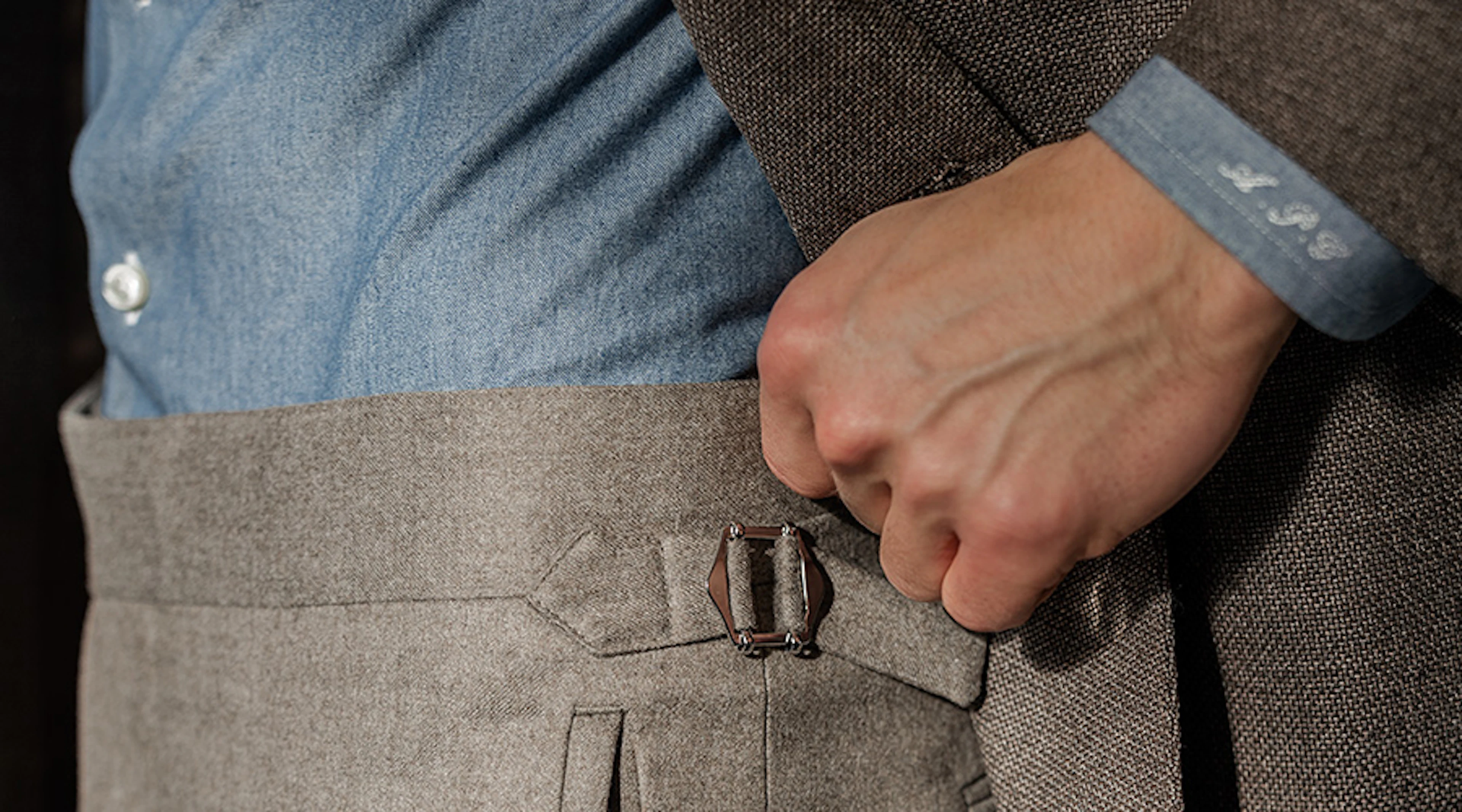
In lieu of belts or suspenders, some gentlemen prefer side adjusters and D-ring straps for trouser support. More commonly found on tuxedo pants that never have belt loops, these handy devices function in the same way as belts and suspenders do without the need for any accessories attached to the pants themselves. One of the most common complaints when it comes to wearing a belt with a suit is the discomfort some people experience when they have to sit down for long periods of time. Trousers with side adjusters normally don't cause the same problems, and while you'll never get the same stylish look as you would with a belt, many gentlemen will take the added comfort over any stylistic concerns.
--Waistband Closures--
Functionally, buttons and hooks serve the same purpose of keeping your trousers closed, but one would be surprised at how many gentlemen prefer one over the other. Buttons have the advantage when it comes to replacement and adjustment, since fixing them doesn't even require a tailor so long as you're somewhat handy with a sewing needle. If your body dimensions tend to fluctuate, buttons can be moved with relative ease. The main disadvantage, however, is that buttons tend to come loose over time, especially with repeated use. They are also vulnerable to small chips and cracks depending on the button's material, so you may end up having to replace them often depending on how frequently you wear a given suit.
Many would say that hooks are stylistically superior to buttons, and this is certainly true for trouser waistbands without any belt loops. Hooks, however, are more difficult to replace as they are sewn into the interior of the waistband and stay at relatively fixed positions. As most hooks are made of metal, they won't ever chip or crack and tend to last much longer than buttons. The upside to their fixed positions is that hooks are much less likely to come loose and fall off, regardless of how many times you put on a given suit throughout its lifespan. With hooks, though, the biggest concern is that they don't always provide the same secure support that buttons will, as hooks can become unhinged throughout any given evening or workday. A properly tailored custom suit, however, shouldn't encounter any of these problems, as proper manufacture and accurate measurements eliminate these issues for the most part.
For those undecided in the hook vs. button debate, some trouser waistbands offer the best of both worlds, normally with a hook on the inside and a button on the far end. This style can provide superior support than either a hook or a button alone, and it also protects against potential embarrassing mishaps if one component fails for some reason. Whether you prefer hooks or buttons, waistband closures are available with or without extensions depending on whether or not you need some extra room.
--The V Split--
One final note worth mentioning is the small split that is sometimes present on trouser waistbands. While it's certainly not necessary and hardly noticeable to most as they can be smaller than a centimeter in width, some waistbands come with a small split toward the very back held together by loose pairs of stitches. Occasionally referred to as the tongue-in-cheek after-dinner split, the main purpose of the V split is not to provide extra room after a heavy meal as the name implies, but to allow better movement of the trouser fabric while you sit down. While this feature is largely something driven by personal preference, some will swear by its added comfort level.
Whether you're eyeing a custom suit for everyday office use or something more formal to wear for your next evening outing, our clothiers at Enzo Custom will help you to determine the best trouser waistband style to your liking. With so many options available, step into one of our showrooms, schedule an appointment online, and look no further.
Begin With a Private Appointment
Explore cloth, fit, and occasion with an Enzo Custom clothier. Reserve a private appointment at your nearest showroom.
No obligation · By appointment
More from the Journal

On Cashmere: Grades, Origins, and What Quality Looks Like
Most men own a cashmere garment. Few can, on inspection, tell whether the garment they own is good cashmere or merely cashmere. The fiber has been so democratized — by the mall brands, by the e-commerce labels, by the seasonal sale racks — that the word itself has lost most of its meaning. The original meaning is recoverable. It requires a small vocabulary and a willingness to handle the cloth long enough to read it.

The Double-Breasted Suit, Considered
The double-breasted suit has spent much of the last forty years out of fashion, then quietly back in it, then out again. Each of these movements obscures a more durable fact: the silhouette is its own grammar, and a man who understands its rules does not need to track its returns. The double-breasted is the most architecturally distinct cut in a man’s wardrobe — and, in its proper form, the most quietly authoritative.

The Black Suit: Considered Beyond Funerals
The black suit has a complicated reputation in contemporary menswear. For decades, it was the suit a man owned for funerals — a single piece in the closet that came out only for sad occasions and was otherwise treated as too somber for ordinary wear. The recommendation in most menswear writing is to skip the black suit entirely and choose a charcoal or navy as the foundational dark suit.