
How To Wear A Watch With Your Formal Attire
Throughout the bulk of the 20th century, it was hard to even think about formal attire—or any attire—without thinking about the sort of watch to correctly pair with it. While a watch is certainly not a required accessory in the realm of formal wear, it almost never hurts your overall presentation. Just as visual presentation goes a long way in how a watch ultimately pairs with a given set of formal attire, so does how the watch functions in terms of placement. While important, the specific design and unique attributes of your watch will always matter less than overall proportionality.
Throughout the bulk of the 20th century, it was hard to even think about formal attire—or any attire—without thinking about the sort of watch to correctly pair with it. As formal wear evolved, the wristwatch became almost as ubiquitous as the necktie and collar stay, with its visual prominence being a handy feature to complement a variety of suit styles for nearly every occasion. For events that called for rigid dress codes such as black-tie dinners and formal weddings, the watch was one of the few accessories that allowed gentlemen to be completely independent in terms of their style choices and could bring a tinge of unique charm to an otherwise uniform presentation among guests.
While watches today are almost as popular as they ever were, they have waned slightly as smartphones have replaced the watch's basic functional utility. A gentleman's ability to quickly glance at the time and date no longer requires a wristwatch, as those basic functions can be hidden away in one's front inside jacket pocket and forgotten. Even with such a technological upgrade, however, the wristwatch can still bring an element of style to your formal ensemble that would otherwise be missing, especially when more and more people these days forego the watch altogether.
From a visual standpoint, a wristwatch worn confidently and correctly has the innate ability to draw focus away slightly from the center of a gentleman's formal attire, which in turn helps bring to light all the other subtle nuances of a given outfit, rather than having the shirt and tie as the sole focal point. Counterintuitively, a watch can provide balance to one's formal wear even when it offsets the visual center to one side. Proportionality, of course, is the key factor when it comes to pulling off this look effectively.
Even with watches not being quite as popular as they used to be, so many different types and styles of wristwatches exist on the market today that have the ability to complement formal attire quite nicely. Still, there are other types that could detract from an overall ensemble or look out of place. In this piece, we'll go over all the ins and outs of wearing a watch correctly with your formal wear, all the way from enhancing your style to the more functional considerations of wearing one.
--Personal Preference--
While a watch is certainly not a required accessory in the realm of formal wear, it almost never hurts your overall presentation. Just as smartphones have become sleeker over the years, wrist watches have also followed this trend to a degree. In previous years one of the biggest complaints about having to wear a watch was its perceived bulkiness and propensity to occasionally snag on one's sleeves. Today this is less of a concern, as watches don't require the same amount of bulk that they used to in order to accommodate all of their inner working mechanisms. Even with a prominent watch face, the watch's depth might only be less than a centimeter. This allows for better and more comfortable pairings with your formal attire, as a sleeker watch won't get in the way of your cuffs or jacket sleeves to any noticeable degree.
Another great benefit to wearing a watch with your formal attire is that it can sometimes have the subtle effect of keeping you more socially engaged in the happenings around you. If you need to check the time, you can simply glance at your wrist without anyone noticing that you're doing it. Checking anything on your smartphone certainly won't go unnoticed, and while we've all been guilty of taking our phones out of our pockets when we probably shouldn't have, it's best to keep them stowed away for most formal occasions, the obvious reason being that it's at the very least considered slightly rude to pull them out mid-conversation.
In spite of how much a wristwatch can add to one's formal attire, there are times when wearing one might be impractical or inconvenient. Considering that the average person might own only three or four watches over their lifetime, sometimes the watches at one's disposal are better suited for activities outside of the formal realm. This is not to say, however, that only expensive watch brands or analog watch faces are appropriate when it comes to formal attire. There are plenty of smartwatches out there with a sleek design that seamlessly complements the finer points of a formal ensemble, just as there are diving watches that could easily pass for something with a more upscale design in mind. Rather than a set price tag or a particular style, the most important things that will determine whether a given watch will work with a formal ensemble is how it looks and whether it's comfortable to wear. Judgment calls with your own eyes can work to your advantage here, so if your watch looks out of place with your three-piece suit or double-breasted jacket, your best bet is to leave your watch at home. Chances are, you'll know it when you see it as far as determining if something works or if something is visually off.
The good news is that there aren't too many rules set in stone when it comes to deciding when and where to don a watch, as it is an accessory that serves a functional purpose in addition to an aesthetic one. Whether you're heading into the office or getting ready for another wedding on your calendar, you can't really go wrong with a wristwatch to help boost the overall visual appeal of your formal ensemble.
Not long ago, however, wearing a watch was discouraged in the context of black-tie affairs, as it was considered rude to look at one's watch during such a formal occasion. This unspoken rule in a modern context doesn't really apply anymore, and it's perfectly acceptable to wear a watch with a tuxedo. If you want to keep at least a shadow of that old tradition alive, choose a watch that has a more restrained, subtler presence over something that's bold and flashy.
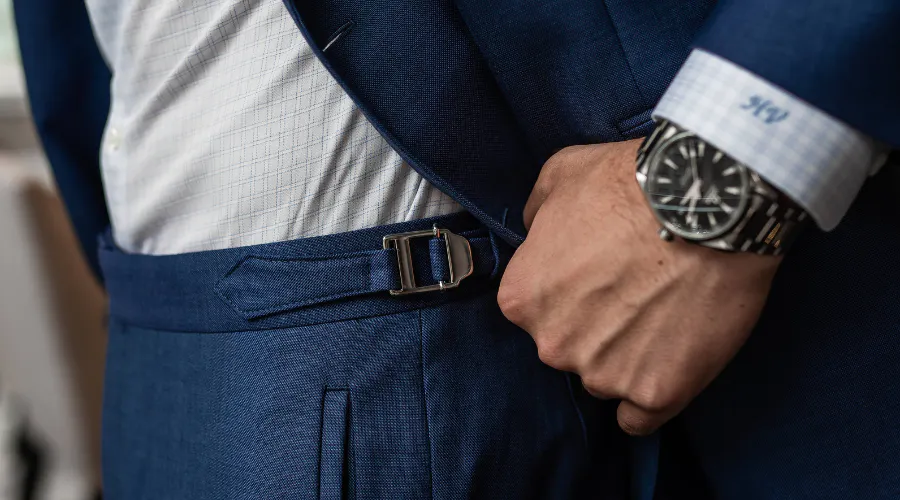
--Functional Considerations--
Just as visual presentation goes a long way in how a watch ultimately pairs with a given set of formal attire, so does how the watch functions in terms of placement.
When accompanying your formal wear with a watch, one of the most important things to consider is the style of your dress shirt cuffs. Under most circumstances, standard barrel cuffs will do just fine, but that all depends on the size of the watch you plan to wear. If your watch face is particularly prominent or the band tends to be on the thicker side, consider wearing a dress shirt with mitered cuffs. The small amount of extra room offered by the beveled edge will allow your watch to sit comfortably at your wrist without causing your shirt cuffs to bunch up or snag.
Most watches that pair well with formal wear have one of two types of bands: metal or leather. From a purely functional point of view, each type has its own pros and cons. Watches with leather bands tend to be more comfortable because they are softer to the touch as well as adjustable. In terms of comfort, metal bands vary because their position is usually fixed while you're wearing them and as a result have to be worn more loosely than a comparable watch with a leather band. No matter your preference, there are a few style considerations to keep in mind with each type.
When wearing a watch with a leather band, the leather should closely match your belt and shoes as a general rule. Matching all three components in this way will provide visual symmetry to your formal ensemble. Since most belts and shoes are made of leather in a formal context, matching a metal watchband to these components to the letter isn't really possible. To solve this problem, you can match your metal watchband to the buckle on your belt instead. While it doesn't have to be exact, matching silver to silver, gold to gold, etc. will go a long way in providing balance to the presentation of your formal wear.
--Style Points--
The specific design and unique attributes of your watch, while important, will always matter less than overall proportionality. A watch face that's too big could detract from the rest of your formal attire, while a watch face that's too small might lessen the desired visual effects you wanted to achieve. On its own, the actual size of the watch face isn't as important as how it compares with other portions of your formal wear. A good rule of thumb to follow here is to try your best to match the size of your watch face with the size of the knot in your necktie. Again, this doesn't have to be exact, but each one will complement the other. Watches with bold prominent faces look best when paired with a Windsor knot, while watches that have a sleeker and subtler appeal to them might be better suited for a Half-Windsor or traditional four-in-hand knot that has a narrower visual spread.
Taking all these different factors into consideration, the only way you'll know whether a watch enhances your formal attire is to try one for size. Whether a watch adds to your custom suit or tuxedo right off the bat or looks like it needs some fine-tuning, you'll likely know it right away by keeping a close eye on any deviations from your personal style preferences and making adjustments to your formal ensemble accordingly.
Begin With a Private Appointment
Explore cloth, fit, and occasion with an Enzo Custom clothier. Reserve a private appointment at your nearest showroom.
No obligation · By appointment
More from the Journal

On Cashmere: Grades, Origins, and What Quality Looks Like
Most men own a cashmere garment. Few can, on inspection, tell whether the garment they own is good cashmere or merely cashmere. The fiber has been so democratized — by the mall brands, by the e-commerce labels, by the seasonal sale racks — that the word itself has lost most of its meaning. The original meaning is recoverable. It requires a small vocabulary and a willingness to handle the cloth long enough to read it.

The Double-Breasted Suit, Considered
The double-breasted suit has spent much of the last forty years out of fashion, then quietly back in it, then out again. Each of these movements obscures a more durable fact: the silhouette is its own grammar, and a man who understands its rules does not need to track its returns. The double-breasted is the most architecturally distinct cut in a man’s wardrobe — and, in its proper form, the most quietly authoritative.

The Black Suit: Considered Beyond Funerals
The black suit has a complicated reputation in contemporary menswear. For decades, it was the suit a man owned for funerals — a single piece in the closet that came out only for sad occasions and was otherwise treated as too somber for ordinary wear. The recommendation in most menswear writing is to skip the black suit entirely and choose a charcoal or navy as the foundational dark suit.