Cuff Styles For Every Occasion
The finer details of one's formal attire come in many forms, all of which serve a functional and stylistic purpose. The cuffs on your dress shirt, trousers, and jacket are no different in this regard, functioning as endpoints of your clothing articles and providing subtle accents to your own personal style. Although many gentlemen don't put too much stock into their cuff styles, the good news is that you have choices when it comes to trousers, jackets, and especially dress shirts. The most important aspect of choosing a cuff style that's right for you rests heavily on how it looks with the rest of your outfit and how practical it is for your personal taste.
The finer details of one's formal attire come in many forms, all of which serve a functional and stylistic purpose. The cuffs on your dress shirt, trousers, and jacket are no different in this regard, not only functioning as endpoints of your clothing articles but also providing subtle accents to your own personal style. No matter the type of cuff you prefer, it should always mesh with the rest of your formal ensemble in a way that brings your style up a notch rather than throwing it off kilter. In other words, your cuff style is one of those things that shouldn't be noticeable right off the bat but instead works its way into the foreground of your formal attire after you've made your rounds and introductions for any given day at the office or evening engagement.
Although many gentlemen don't put too much stock into their cuff styles, the good news is that when it comes to trousers, jackets, and especially dress shirts, you have choices. What you ultimately choose, however, may end up resting with the particular degree of formality you need for a specific occasion. Cuffs that look nice at the office might not be the best choice for a black-tie dinner and vice versa. From a functional standpoint, French cuffs aren't the most convenient style if you tend to roll up your sleeves at the end of the day. Likewise, a standard barrel cuff could be cumbersome if you normally wear a watch on a daily basis. Depending on your preferred choice of shoes, your trousers may need a longer cuff length.
The most important aspect of choosing a cuff style that's right for you rests heavily on how it looks with the rest of your outfit, as well as how practical it is for your personal taste. In this piece, we'll go over the more common cuff styles associated with formal wear so you'll be more prepared when you need to add another jacket, dress shirt, or pair of pants to your wardrobe.
--Dress Shirts--
When most people think of cuff styles, the dress shirt is usually the first thing that comes to mind. This isn't really all that surprising when you consider that dress shirts, compared to other pieces of formal attire, tend to have the most options as far as cuff styles go.
The barrel cuff is something all of us have encountered at some point or another, as it is the most common style and not exclusive to formal dress shirts. Many casual long-sleeve shirts made from materials such as denim and corduroy also utilize the barrel cuff due to its simplicity, versatility, and ease of manufacture. In the context of formal wear, the barrel cuff offers a classic, subtle, and restrained look ideal for everyday office attire as well as daytime and evening engagements outside of the workplace. The barrel cuff is normally offered with one button sewn in, which allows the cuff to stay relatively flat around your wrist as opposed to jutting out.
Almost visibly indistinguishable from a barrel cuff, the two-button rounded cuff is slightly longer and, as its name would obviously indicate, offers an additional button. From an aesthetic standpoint, the two-button cuff is a tad more formal than its one-button barrel counterpart, yet still offers the same degree of restraint and subtlety.
Mitered cuffs come in both one- and two-button varieties, easily distinguishable by a beveled edge at the outer button closure. Offering a slightly sharper stylistic form compared to other dress shirt cuff types, mitered cuffs are popular with gentlemen who prefer wearing watches due to the extra space provided by the angled end. Wearing a watch with barrel and rounded cuffs can occasionally cause issues with comfort and bunching. Mitered cuffs alleviate these potential problems.
Although less popular today than they were in their heyday, cocktail cuffs are worth mentioning for their unique appearance. Also known as turn-back cuffs and James Bond cuffs due to their association with the iconic character, the cuffs when laid flat have two buttons and a parabolic edge. The unconventional design yields an eye-catching visual presentation, as the cuff is meant to be folded over itself once and expose the buttons on the underside of the cuff between the edges that meet together at the wrist. Some dress shirts with this style are even deliberately tailored to show off color or pattern on the bottom of the cuff that differs greatly from the rest of the shirt when enhanced accents and contrasts are desired.
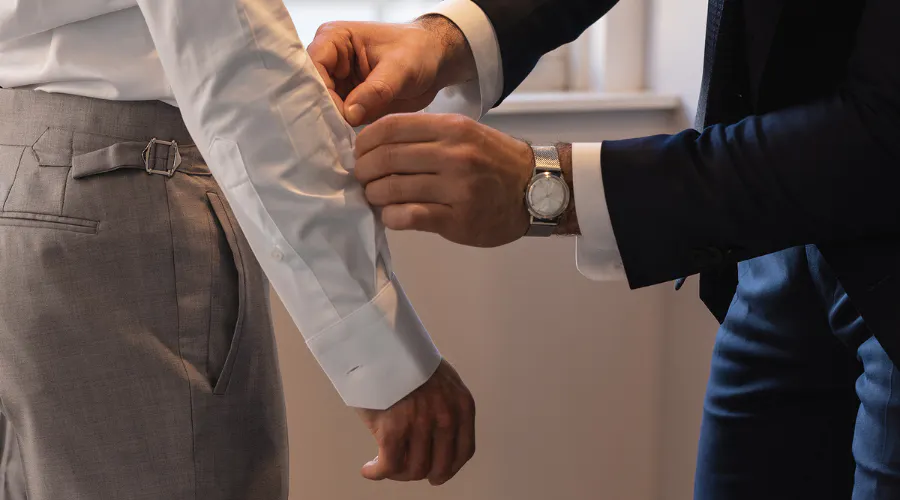
Compared to other dress shirt cuff types, the French cuff is considered to be more formal than the rest. Popular with black-tie engagements and events where a three-piece suit would be appropriate, French cuffs can effortlessly add a layer of flair to your ensemble. Unlike other styles where cufflinks are optional, French cuffs always require cufflinks in lieu of buttons sewn into the shirt fabric, making them easily recognizable. The ends of the cuff protrude out instead of staying circular around the wrist, which allows even more style variation based upon the potential endless selection of cufflinks one has at their disposal. Just be sure to wear your cufflinks so the ornamental side of them is facing out. This rule should also be followed if you opt to use cufflinks for other dress shirt cuff styles.
--Trousers--
The cuffs on your pants will largely depend on the degree of formality you seek. In the context of formal wear, many trouser types omit cuffs altogether due to their perception of being more appropriate for casual affairs, but this wasn't always so. In place of cuffs, the way in which the pants are hemmed becomes the stylistic equivalent. This is not to say that trouser cuffs are completely absent from the formal realm, only that cuffed pants have gradually fallen out of favor while the flat, sleeker look of the hemline is preferred.
The standard for most suit pants these days is the plain hem, where the lower edge of each pant leg is parallel to the ground. Stylish as it is versatile, the plain hem works well to complement suit styles across the board and an equally diverse number of shoe pairings. Depending on personal preference and functional considerations such as shoe size and overall stature, the height of a plain hemline can be adjusted by a tailor if necessary.
In comparison, a slanted hem is angled away from the ground slightly, providing a sharper, more defined aesthetic. While this style has potential to enhance your formal wear, you should consider it carefully, as it can also have the opposite effect by turning a perfectly tailored suit into an awkward spectacle that will certainly stand out, just not in the way you want it to. The main benefit of a slanted hem is to accommodate certain types of shoes that taper up toward the heel. A plain hem in this case could appear too baggy or even snag if the hemline is too long, so opting for the slanted hem may be the better choice depending on the particular pair of shoes you choose to wear with a given suit in your wardrobe.
In spite of their waning popularity, some gentlemen still opt for trouser cuffs over having the hemline exposed. Ideal for everyday workplace settings, trouser cuffs can provide a subtle softness to an outfit that otherwise would be absent, so long as the suit pants are pleated. While there's no rule set in stone regarding the length of the cuff, between 1.5 and 2 inches is generally considered to be standard. Proportion to a person's height tends to be more important than the exact measurement of the cuff itself.
--Jacket--
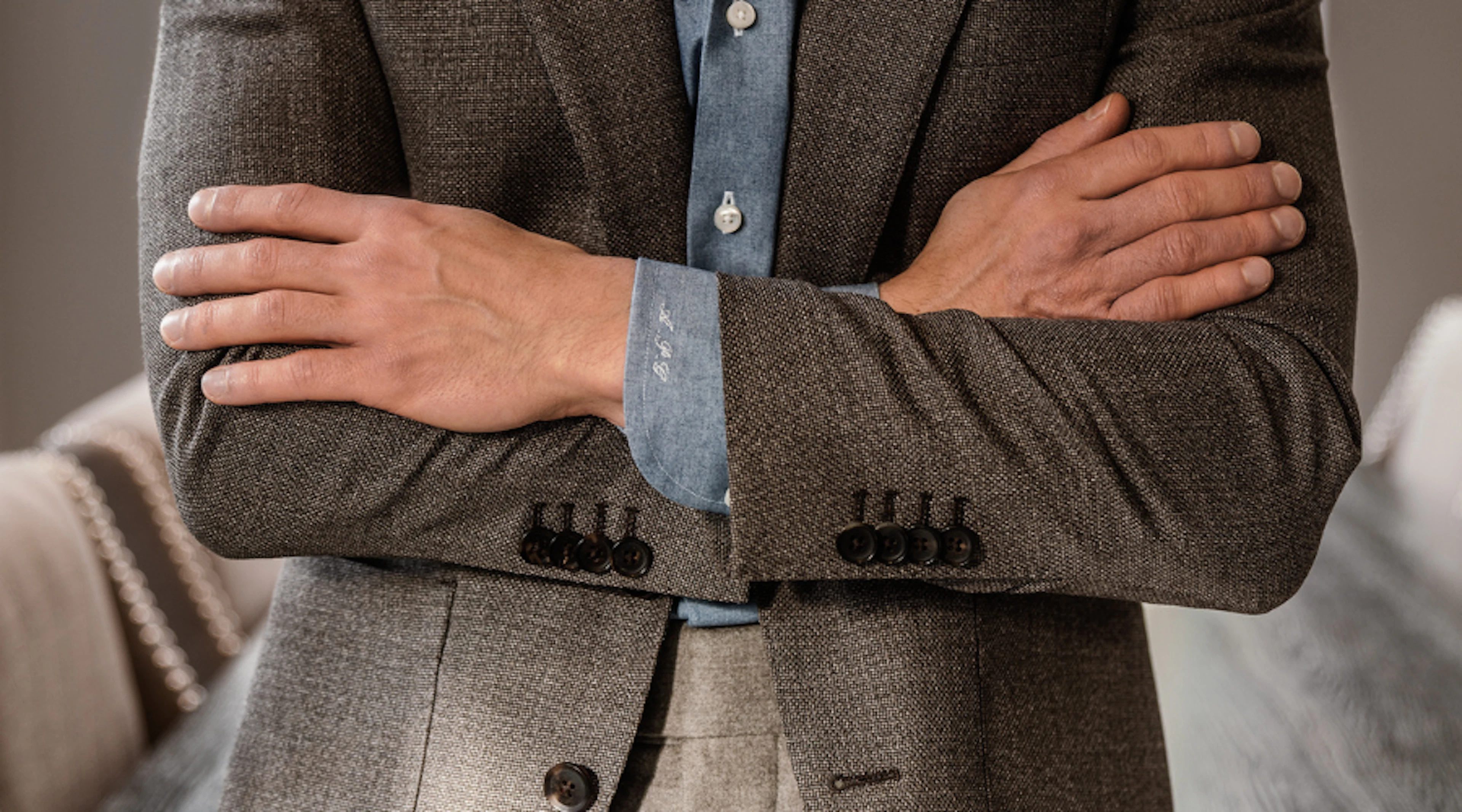
While the cuffs on your jacket are never meant to be rolled or folded in the same vein as the cuffs on your dress shirts and trousers, they do exist. For jacket cuffs, closer attention is paid to how the buttons are laid out and how many are present. When it comes to formal custom suits today, four buttons is the most common number for the main British, American, and Italian styles. It's also not uncommon to see jackets with three buttons at the cuff, although as a general rule, the presence of fewer buttons translates to a lower degree of formality. Suit jackets with one or two buttons at the cuff are less common, but some gentlemen prefer the understated look that fewer buttons can offer, even in formal settings; it can work so long as the suit is properly tailored and carries its own weight in terms of form and aesthetic presentation.
The buttons on the cuffs of your suit jacket are normally laid out, or finished, in one of two ways: working or slanted. Working buttonholes, sometimes referred to as surgeon's cuffs, are parallel to the ground while slanted ones are angled slightly away from the floor when the jacket is in a vertical resting position. Many suits today also come standard with decorative buttons only, which means no buttonholes are present, but this jacket cuff type is more common with off-the-rack options. Bespoke and custom suits tend to be offered with functional buttonholes, even though their main purpose is to be decorative. While they can technically be undone and rolled up, in most circumstances they should always stay fastened. Choosing which type for your suit jacket comes down to a matter of personal preference, as all the aforementioned types are acceptable in formal settings. Slanted buttonholes, however, might be better suited to your personal style sensibilities if you desire a bit more of an edge.
Aside from the buttonholes, the buttons themselves on your suit jacket cuffs can be arranged and spaced to your liking. Considered to be one of the more minute details of formal wear, men who pay more attention to these subtleties will appreciate the additional choices. The most common arrangement is for the buttons to be flat; in other words, evenly spaced with no overlap. When the buttons are in a kissing arrangement, the ends of each button just barely touches the next one, which requires closer spacing and stitching. Waterfall button arrangements present a unique visual, where each button overlaps the one above it.
--Options, Options, and More Options--
With so many cuff styles along with the resulting greater number of combinations possible when you consider how to perfectly pair the cuffs on your dress shirts, jackets, and trousers together, nailing down the exact look you want for a given formal ensemble isn't always easy. Here at Enzo Custom, our clothiers can guide you in the right direction, as every custom suit will never look quite the same when you consider those finer, subtler details. Whether you're ready to add some new formal wear to your wardrobe or simply need to tweak some of those finer points, don't hesitate to schedule an appointment with us in one of our stores or digitally from the comfort of your own home.
Begin With a Private Appointment
Explore cloth, fit, and occasion with an Enzo Custom clothier. Reserve a private appointment at your nearest showroom.
No obligation · By appointment
More from the Journal

On Cashmere: Grades, Origins, and What Quality Looks Like
Most men own a cashmere garment. Few can, on inspection, tell whether the garment they own is good cashmere or merely cashmere. The fiber has been so democratized — by the mall brands, by the e-commerce labels, by the seasonal sale racks — that the word itself has lost most of its meaning. The original meaning is recoverable. It requires a small vocabulary and a willingness to handle the cloth long enough to read it.

The Double-Breasted Suit, Considered
The double-breasted suit has spent much of the last forty years out of fashion, then quietly back in it, then out again. Each of these movements obscures a more durable fact: the silhouette is its own grammar, and a man who understands its rules does not need to track its returns. The double-breasted is the most architecturally distinct cut in a man’s wardrobe — and, in its proper form, the most quietly authoritative.

The Black Suit: Considered Beyond Funerals
The black suit has a complicated reputation in contemporary menswear. For decades, it was the suit a man owned for funerals — a single piece in the closet that came out only for sad occasions and was otherwise treated as too somber for ordinary wear. The recommendation in most menswear writing is to skip the black suit entirely and choose a charcoal or navy as the foundational dark suit.