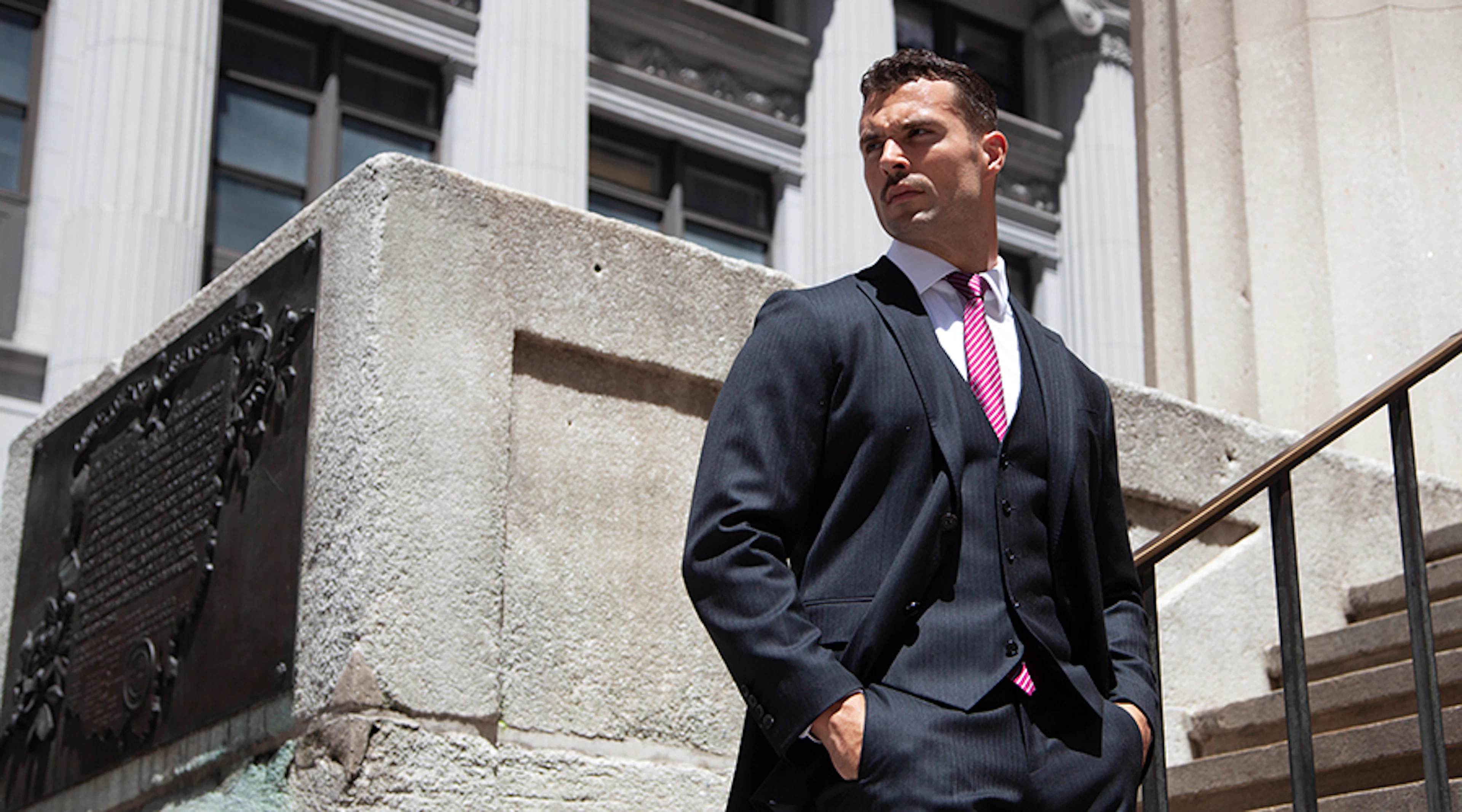
A Comprehensive Guide To Three-Piece Suits
It's no surprise that the standard two-piece suit has become the dominant fashion trend in most formal settings around the world, especially as formal wear has lost a little bit of its former midcentury glory and prestige. With office dress codes skewing more casual—even more so as of late—and white-tie events going all but extinct, formal wear has become more minimalist, uniform, and simplified. But the three-piece suit is an alternative means to meet that former formal glory halfway.
It's no surprise that the standard two-piece suit has become the dominant fashion trend in most formal settings around the world, especially as formal wear has lost a little bit of its former midcentury glory and prestige. With office dress codes skewing more casual—even more so as of late—and white-tie events going all but extinct, formal wear has become more minimalist, uniform, and simplified. Of course this isn't necessarily a bad thing; getting ready for special outings takes much less time than it used to and gentlemen are no longer burdened with having to keep an entire closet exclusively dedicated to formal wear. The modern conveniences of no longer having to put on a tuxedo to board a cruise ship or eat at fancy restaurants is certainly something to celebrate rather than deride. But sometimes we all long for that former charm, largely missing from the modern-day cocktail party, board meeting, and evening soirée. Save designated black-tie events, weddings, and a select few awards ceremonies, the tuxedo can sometimes be too much, drawing attention to your style preferences rather than your charming personality. But the three-piece suit is an alternative means to meet that former formal glory halfway.
The origins of the three-piece suit can be traced back to the mid 17th Century, when King Charles II of Britain encouraged the wearing of vests (or waistcoats as they are also known) as a way to pump up the wool trade. In the 19th Century, Beau Brummell, the man largely responsible for the toning-down of formal wear that ultimately replaced elaborate and complicated garments, was also instrumental in turning the waistcoat into standard bespoke flair.
Although the three-piece suit has declined in popularity since its peak in the middle of the 20th Century, it is still able to hold a niche interest; as formal events are rarer overall, some gentlemen are more inclined to deck themselves out whenever the opportunity arises, and the three-piece suit is a simple yet elegant way to give one's style that extra edge it might be missing.
In this article, we'll give you all the ins and outs of the three-piece suit, including special considerations, what you'll need with it, how to wear it, and how to use it to your advantage by illuminating your personal style. After all, the three-piece suit is more than just a regular suit with an added vest.
--Benefits Over Two-Piece Suits--
While all formal suits come equipped with jackets and trousers, the addition of the waistcoat is the main component that differentiates the three-piece suit from its more common two-piece counterpart. Simply by virtue of this extra layer, three-piece suits have the added benefit of providing more insulation to your person during the colder months out of the year, allowing you to think twice about having to lug around a heavy overcoat just to stay comfortable. Three-piece suits also tend to be made from heavier wool than two-piece ones; while this isn't standard across the board, it's common enough to consider adding a three-piece suit to your wardrobe if you happen to live in more frigid climates.
Other than staying comfortable in the cold, three-piece suits will enhance your overall style with very minimal effort. As the old adage goes, a classic never dies, and the three-piece suit is more than capable of resurrecting those past sensibilities of class and sophistication that are sometimes absent in more modern, dressed down apparel selections. When the occasion calls for it, don't be shy about rocking a three-piece suit, as you'll certainly appear more confident and collected as far as your own personal style goes.
A beneficial unintended consequence of owning a selection of three-piece suits is the effortless increase in wardrobe permutations by default at your disposal. For those more casual occasions on warmer days where a full suit is not required, you'll have a plethora of vests to choose from when all you need is something on the business-casual side of things. Even when a particular outing still calls for a blazer, you can, in a pinch, get away with using one of your suit jackets as a sport coat without raising any eyebrows. While you'll still look your best in a full three-piece suit, this added flexibility can come in handy when you need formal wear or some combination thereof at short notice.
--Minor Drawbacks--
Before we get into some of the finer points of style surrounding the three-piece suit, we wouldn't be completely comprehensive about them if we didn't cover some of the minor drawbacks that can arise with them.
Due to the heavier nature of the material and the added vest layer that are both beneficial in the winter, three-piece suits aren't always the best pieces of formal wear to strut around town during the summer. For events outside, a three-piece suit can be especially troubling when your goal is to stay cool and comfortable. The waistcoat sometimes has a tendency to make the rest of your outfit bunch up more easily, but this can be mitigated with proper measurements and fitting.
For some outings and events, a three-piece suit might just be a bit too much, even when you're trying to be subtle about your superiority in style. As events during the day tend to be less formal than those held at night, you might want to opt for a more modern two-piece suit when you're required to be formal during daylight hours and save the three-piece suit for evening affairs.
Just as the waistcoat once served a more practical purpose for the tuxedo, the same can be said for three-piece suits. Although vests today are more of a fashion statement than anything else, they were once a necessity to conceal suspenders that at one time were considered to be an undergarment. As a result, the three-piece isn't very suited to accommodate belts at all. This pairing would not only look awkward but also cause problems with bunching up, fit, and comfort. If your measurements are just right, then you don't really need any extra pant support. But if you want to be on the safe side, opt for suspenders in lieu of a belt. They will keep your pants from sagging down and as a result, your dress shirt won't protrude through the lower part of your waistcoat. The last thing you want is to grapple with a belt buckle snagging on your vest when you stand up or sit down, and there's a reason why most pants made for three-piece suits don't have any belt loops at all. This isn't so much of a drawback as it is a practical consideration, so logic would follow that if you don't see belt loops, don't even think about using one.
--Wearing It In Style--
Just as the same general rule applies to two-piece suits, the jacket, trousers, and vest of a three-piece suit are all designed to match each other. In the context of formal occasions, it's best not to deviate from this rule, even if you might be tempted to mix and match your vests and your jackets. The latter should only be reserved for casual affairs or when you're not required to wear a jacket. A mismatched vest or any other suit component will stick out like a sore thumb otherwise, and you're better off complementing your personal style rather than detracting from it.
Another important yet often overlooked style concern is how to button your waistcoat. As the rule goes for suit jackets and tuxedos, the bottom button of your vest should always be left unbuttoned. While this is mainly a point of style that has survived for decades if not longer, leaving the last button open will also allow for more flexibility and comfort when you stand up or sit down. Keep in mind, however, that the waistcoat should cover the bottom part of your shirt to ensure aesthetic uniformity of the suit fabric from your feet all the way up to your shoulders. Any part of your shirt that protrudes between the waistline and the bottom of your vest will tarnish any semblance of style sophistication you'd want to achieve with a three-piece suit.
Per the aforementioned style consideration, proper measurements when it comes to three-piece suits are especially important. Since belts are out of the question as we mentioned previously, a proper fit will ensure that your suit stays presentable and comfortable throughout its lifespan. If you need extra support to keep your trousers sitting at the natural waistline, opt for suspenders that button into the inside of the pants; never use the clip-on variety, and that goes for other types of formal wear, as well.
--Quick Tips and Style Tricks--
Given the heavier nature of the material associated with three-piece suits and the added vest layer, we would suggest that you wear a shirt that's made from a lighter material such as silk, linen, light wool, or blended cotton. Any flannels or heavier wools are bound to cause discomfort, especially in warmer climates.
When you sit down, you should make it a habit of unbuttoning your suit jacket but not the waistcoat. This will give you more wiggle room at the dinner table and will also prevent the suit from bunching up. The same etiquette goes for tuxedos and standard two-piece suits as well.
As with all suits, it's best not to wear a shirt that's the same color as your vest, jacket, and trousers. While any suit should be uniform in its fabric all the way through, your shirt should add a slight amount of softness and contrast to your outfit. The only exception to this rule might be wearing black on black (i.e. black suit, black vest, black shirt, black tie, etc.), but this look is often too monochromatic and too severe for many people to pull off well. If you choose to go that route, we'd suggest that you do it sparingly.
One final style consideration to keep in mind is your socks. Because the waistline is generally higher with a three-piece suit than it is with its two-piece counterparts, you especially need to make sure that your socks are high enough to accommodate cuffs that are slightly higher as well, in particular when you are sitting down.
If you're ready to make the leap toward adding a three-piece custom suit to your wardrobe, feel free to stop into an Enzo Custom showroom where an expert clothier will take your measurements and answer all your questions. If you feel more comfortable at home, you can also schedule an appointment with us via videoconference.
Begin With a Private Appointment
Explore cloth, fit, and occasion with an Enzo Custom clothier. Reserve a private appointment at your nearest showroom.
No obligation · By appointment
More from the Journal

On Cashmere: Grades, Origins, and What Quality Looks Like
Most men own a cashmere garment. Few can, on inspection, tell whether the garment they own is good cashmere or merely cashmere. The fiber has been so democratized — by the mall brands, by the e-commerce labels, by the seasonal sale racks — that the word itself has lost most of its meaning. The original meaning is recoverable. It requires a small vocabulary and a willingness to handle the cloth long enough to read it.

The Double-Breasted Suit, Considered
The double-breasted suit has spent much of the last forty years out of fashion, then quietly back in it, then out again. Each of these movements obscures a more durable fact: the silhouette is its own grammar, and a man who understands its rules does not need to track its returns. The double-breasted is the most architecturally distinct cut in a man’s wardrobe — and, in its proper form, the most quietly authoritative.

The Black Suit: Considered Beyond Funerals
The black suit has a complicated reputation in contemporary menswear. For decades, it was the suit a man owned for funerals — a single piece in the closet that came out only for sad occasions and was otherwise treated as too somber for ordinary wear. The recommendation in most menswear writing is to skip the black suit entirely and choose a charcoal or navy as the foundational dark suit.