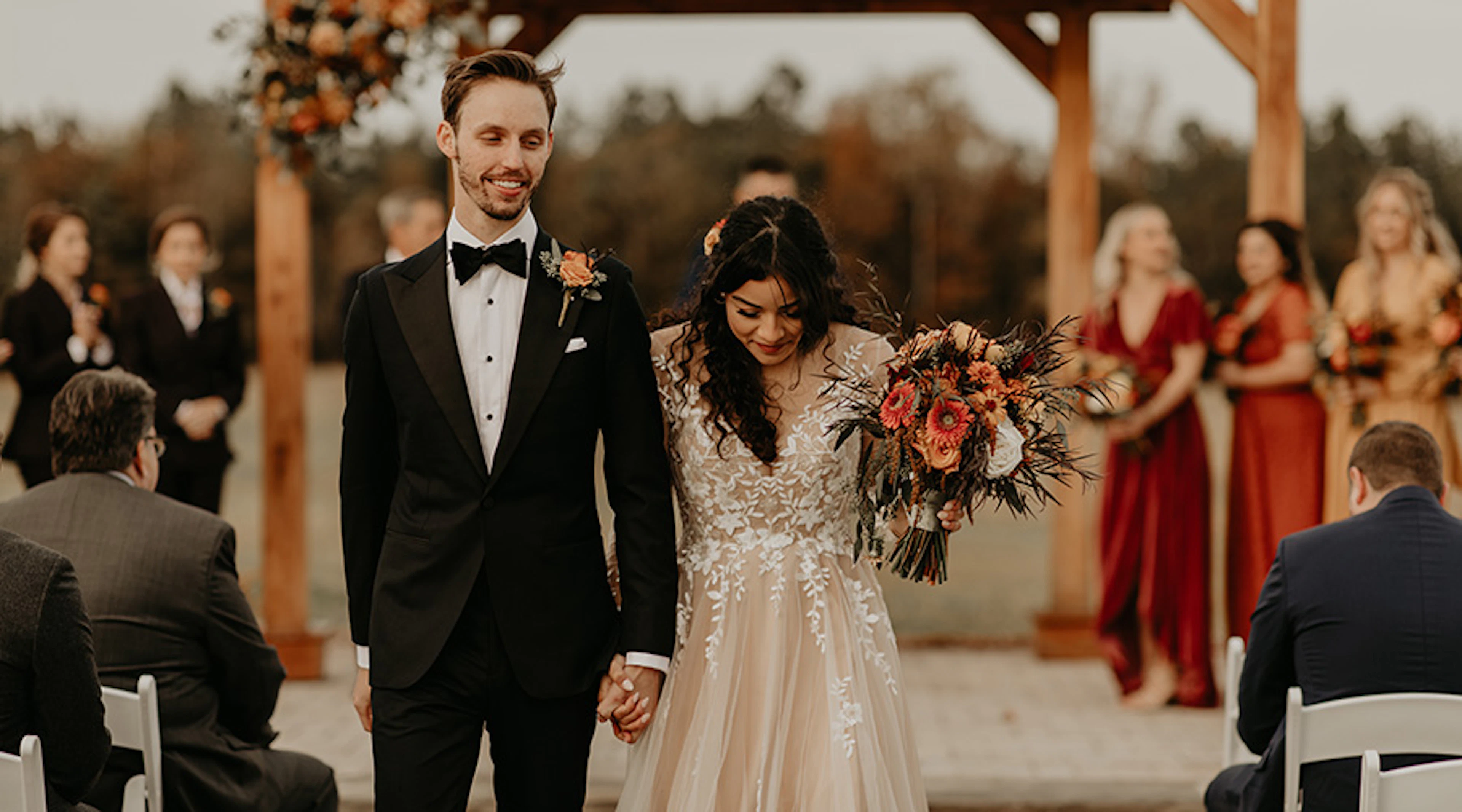
The Wedding Dress Code Debate: To Have Or Not To Have
It goes without saying that one's wedding day is one of the most important, if not the most important day in a person's life. It's expected that most people want to look their best whenever they reach that unforgettable life milestone.
It doesn't matter if you're set on going all in on an elaborate ceremony at a swanky hotel or tying the knot in front of a justice of the peace; it goes without saying that one's wedding day is one of the most important, if not the most important day in a person's life. Surrounded by extended friends and family or saying "I do" in a more intimate and private ceremony, it's expected that most people want to look their best whenever they reach that unforgettable life milestone.
With that milestone, of course, come plenty of stressful moments in a wedding's planning stages as couples try to nail down their version of the perfect day. Figuring out the venue, catering, guest lists, entertainment, and other logistical nuances can be overwhelming, especially when you haven't done something as grand as putting on a wedding before. On top of all the many things planning a wedding entails, one of the simplest things to decide on also happens to be one of the most contentious, and we're talking about dress codes. No matter what you ultimately choose to do, it's pretty much impossible to satisfy everyone in attendance, so before we go on, keep one thing in mind: do what feels right, for you and your spouse-to-be. That being said, there are certain things that can guide you more or less in the right direction when it comes to selecting a dress code—or none at all—for your wedding.
Common wedding dress codes include black-tie, black-tie optional, formal, casual, cocktail, and everyday. But even when you don't spell out a dress code on the invitations, weddings will tend to have an implied dress code most guests will be primed to follow, almost always skewing toward formal and cocktail attire. Although you ultimately must do what you want to do, certain dress codes will have a better chance of keeping your guests happier than others. And nothing quite makes or breaks a wedding like the overall vibe of the crowd in attendance.
In any event, the best thing to do when it comes to dress codes for your wedding is at the very least make sure your guests get the memo. There's nothing worse than having your guests show up to a wedding where they find themselves either one-upping the bride and groom or feeling underdressed and out of place. In this piece, we'll go over the best ways in which to go about finding that perfect dress code for your perfect day, whether you're looking for something traditional or a little more outside the norm.
--Setting--
Aside from the type of venue and the size of your wedding, the geographic location of your ceremony and reception is an important factor to consider when you're shopping around for different dress codes. Holding a wedding right on the beach close to the water might require a different sort of suit than a wedding held at a fancy hotel. Likewise, a destination wedding far away from most of your family and friends may require a more flexible dress code than if you were to hold your ceremony indoors somewhere locally. Nothing is ironclad of course, but as a general rule, the farther distance required for your guests to travel, the more forgiving your wedding dress code should be. Most people own at least one suit and won't have a difficult time picking one up if they don't, but not everyone has a tuxedo or a white-tie ensemble at their disposal. While it's ultimately up to you, it never hurts to take the logistical concerns of your guests into consideration when you're on the fence about going with a black-tie-only or a more standard formal dress code.
Although it's less of a concern when you're holding your wedding at an indoor venue, you may also want to consider the time of year in deciding which dress code, or variation thereof, would be best. Opting for a black-tie wedding in most geographic locales could work very well during the fall and winter months when the air tends to be cooler and drier; the extra components of a tuxedo are less inclined to make your guests uncomfortable when the weather calls for a few extra layers. Conversely, when the weather gets warmer, a semi-formal or cocktail dress code might be better suited for your guests, as it will give those in attendance a little bit more flexibility.
--Black-Tie Only--
In recent years it's becoming more common for wedding invitations to specify black-tie attire for the ceremony. While there are many benefits to a black-tie-only wedding, the overall consensus is mixed on the practice. If you receive a wedding invitation that indicates black-tie only, it means what it says. The guests in attendance are expected to wear proper black-tie attire: tuxedos for men, evening gowns for women.
The greatest benefit to a black-tie-only dress code is the uniformity it can bring to a wedding ceremony, as your guests will not have to play a guessing game when it comes to the attire they're supposed to wear. Without confusion over the dress code, so long as everyone in attendance follows what the wedding party expects, the partygoers are less liable to stand out by being either overdressed or underdressed. Your wedding photos could also end up looking more professional when everyone in attendance is donning their best formal attire.
Imposing a black-tie-only dress code, however, can sometimes draw the ire of your wedding guests, especially if they had to travel a great distance to get there. In addition to plane tickets and lodging, your guests may have to incur the extra expense of purchasing or renting a tuxedo or evening gown if they didn't already have one on hand in their wardrobe. You also run the risk of your guests simply disregarding the dress code to varying degrees, which could cause a bit of awkwardness depending on how rigidly dress codes are enforced in your social circles.
--Black-Tie Optional--
Rather than outright mandate tuxedos and evening gowns, some couples opt for a black-tie-optional dress code on their big day. Unlike black-tie-only affairs, the black-tie-optional dress code allows for more choices and more flexibility in terms of what guests are expected to wear. For black-tie-optional events, it's perfectly fine to wear a full tuxedo, but formal dark suits and unconventional variations of the tuxedo are also acceptable. It's easy to think of black-tie optional as any mode of dress that fits somewhere between full black tie and a notch or two above cocktail attire.
A black-tie-optional dress code is a great way to balance formality with convenience. It conveys a sense of importance without forcing your guests to make last-minute purchases or taking extra time to get ready. For couples who want all the formality of a black-tie wedding without some of the hassles that can come with it, black-tie-optional provides balance among the upper tiers of formal dress codes and still allows your guests to look their very best.
There are, of course, a couple downsides that come with a black-tie-optional dress code. Compared to black-tie only, you'll have to contend with the loss of uniformity as far as your guests' ensembles go. Any dress code that has optional in its name is going to allow for more deviations that may even surpass what is expected in terms of formality. Black-tie optional is still a formal dress code; it doesn't mean that anything goes. Unfortunately, some of your guests may be confused by this and end up wearing something far more casual that's not exactly appropriate for the occasion. While it is a risk and our combined experience has seen our fair share of outlandish outfits when the dress code isn't necessarily set in stone, it's a small risk since black-tie optional implies formality in its name. In most cases, especially at weddings, the benefits of black-tie optional still outweigh any potential drawbacks.
--Cocktail--
Although a tier down from black-tie optional in terms of formality, cocktail attire has been a popular wedding dress code for the better part of a century. Men are generally expected to wear a suit and tie, but the unspoken rules about colors and patterns tend to be more relaxed. Cocktail attire seeks to find that happy medium between comfortable and sophisticated, allowing guests to look their best but also feel casual while they do it.
Opting for cocktail attire in lieu of more formal dress codes can put your guests' minds at ease, as they'll be able to enjoy the ceremony and reception without worrying too much about tuxedo studs falling out or bow ties that are too off center. The variety resulting from less restrained individual styles can also really liven up a party. Even something as simple as a pocket square can make for a good talking piece when it's worn with confidence.
Since there's a bit of a grey area between cocktail attire and modes of formal and semi-formal dress, there's a chance that some of your guests might show up either overdressed or underdressed. It's pretty much a given that it's better to be overdressed in most circumstances, and more often than not people have a good idea of what is appropriate and what isn't. In any case, it's unlikely that any of your guests will feel left out if they unwittingly forego a jacket or tie, as the broader spread of style variations within cocktail attire can be a good cover for the few who may have neglected the finer points of that particular style.
At the end of the day, the dress code at your wedding should reflect what feels right for your individual sensibilities. While some couples may encourage their guests to simply come as they are, others want the full wedding experience that comes with a more elegant mode of dress. Tailoring the dress code on your big day is just as important as tailoring your formal wear with personal style in mind. Whether you choose to get married on the beach in an exotic location or in a more traditional setting with church bells and ballrooms, the key is to make it memorable, however you decide to go about it.
Begin With a Private Appointment
Explore cloth, fit, and occasion with an Enzo Custom clothier. Reserve a private appointment at your nearest showroom.
No obligation · By appointment
More from the Journal

On Cashmere: Grades, Origins, and What Quality Looks Like
Most men own a cashmere garment. Few can, on inspection, tell whether the garment they own is good cashmere or merely cashmere. The fiber has been so democratized — by the mall brands, by the e-commerce labels, by the seasonal sale racks — that the word itself has lost most of its meaning. The original meaning is recoverable. It requires a small vocabulary and a willingness to handle the cloth long enough to read it.

The Double-Breasted Suit, Considered
The double-breasted suit has spent much of the last forty years out of fashion, then quietly back in it, then out again. Each of these movements obscures a more durable fact: the silhouette is its own grammar, and a man who understands its rules does not need to track its returns. The double-breasted is the most architecturally distinct cut in a man’s wardrobe — and, in its proper form, the most quietly authoritative.

The Black Suit: Considered Beyond Funerals
The black suit has a complicated reputation in contemporary menswear. For decades, it was the suit a man owned for funerals — a single piece in the closet that came out only for sad occasions and was otherwise treated as too somber for ordinary wear. The recommendation in most menswear writing is to skip the black suit entirely and choose a charcoal or navy as the foundational dark suit.